
Dental care is very important for both humans and animals. For guinea pigs, stinky breath usually means that there’s a problem with either stomach or teeth.
What are guinea pig teeth? Teeth are very important organs in your guinea pig’s body. They use their teeth to grind some hay or any food you give to them. As such, they should be treated well and with care. If you notice that your guinea pig has some problems with its teeth, you should definitely take it to the nearest vet.
Last reviewed and updated for 2026 — fact-checked against current exotic-vet guidance, with corrected advice on salt blocks and vitamin C and an added at-a-glance dental-problems table.
Table of Content
Quick Answer: Guinea Pig Teeth & Dental Health
- Guinea pigs have 20 teeth — four incisors (front), four premolars, and twelve molars — and no canines. All of them are open-rooted and grow continuously for life (incisors grow roughly 1–2 mm a week).
- Constant chewing keeps them healthy. The teeth wear down naturally only if your guinea pig grazes on plenty of fibrous food, so unlimited grass hay (about 80% of the diet) is the single best thing for their teeth.
- The most common serious problem is overgrown molars (cheek teeth), not the front teeth — and you usually can’t see it without a vet looking inside the mouth.
- Watch for warning signs: drooling or a wet chin, dropping food, eating less, weight loss, or watery eyes. Any of these means a vet visit.
- Vitamin C matters too — guinea pigs can’t make their own, and a shortage weakens the teeth and gums. Aim for about 10–30 mg a day.
- Never trim or clip the teeth yourself. An exotic vet files (burrs) overgrown teeth safely — clipping at home can crack a tooth and cause an abscess.
This article is here to inform you about guinea pigs and their teeth. We’ll talk about everything from typical dental problems to their teeth in general. If you’re willing to learn something new, let’s start!
Guinea Pig Teeth | What You Need to Know
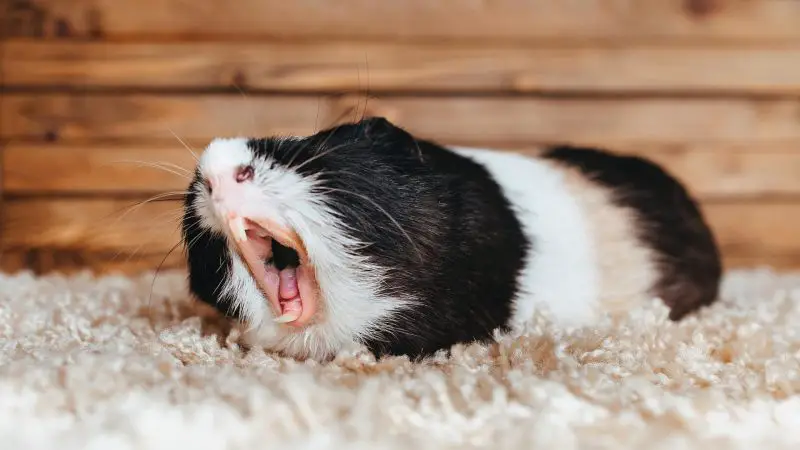
Guinea pigs have 20 teeth in total: four incisors at the very front (two on top, two on the bottom), four premolars, and twelve molars further back. Importantly, every one of these teeth — not just the front incisors — grows continuously throughout your guinea pig’s life, so all of them rely on constant chewing to stay the right length.
Unlike many predator animals, guinea pigs don’t have canines. It means that they can’t slaughter an animal like a lion would do. This goes hand to hand with guinea pigs, though. As they’re herbivorous animals, they don’t need two pairs of canines.
Between their upper and lower incisors, they have a tiny gap. This gap is called a diastema. It’s also important to mention that their teeth are open-rooted, meaning that they’ll grow indefinitely.
Preventing their teeth from growing further is simple – get some food! When guinea pigs chew, they don’t only remedy this problem but also take care of their dental health, which is crucial for an animal like this.
Still, their front teeth are very sharp and can easily chew down things like your furniture. That being said, don’t let your guinea pig chew everything it sees. It’s important to mention that guinea pigs’ teeth should be white, which represents a healthy color.
What If Your Guinea Pig Refuses to Eat?
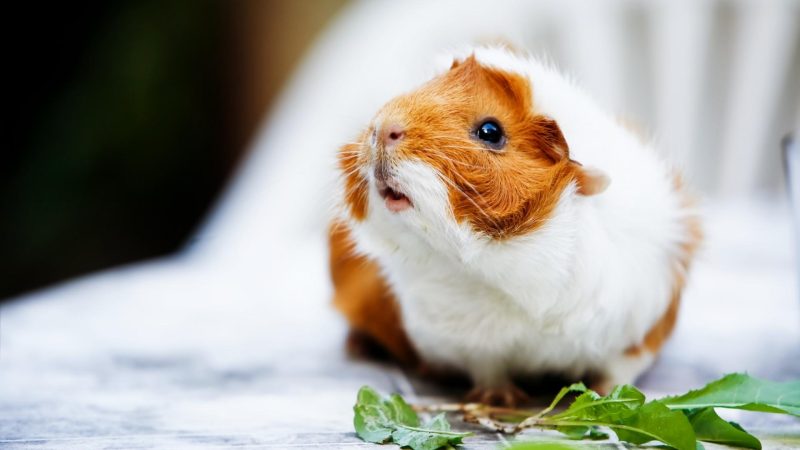
The experienced guinea pig owners know that guinea pigs sometimes just won’t eat. One time, they’re full and they can’t take a single bite. Other times, it may be a digestion problem or simply a dental problem.
In the case of digestion problems, the symptoms can almost always be seen. However, dental problems can be latent as guinea pigs don’t flinch when they feel the pain in their mouth.
In the case its appetite ceases, you should always consider dental problems. It can go so seriously that guinea pigs can develop anorexia. In guinea pigs, anorexia represents a severe loss of appetite. The loss of appetite leads to weight loss.
If your guinea pig refuses to eat for a couple of days, taking it to a vet is very important. In fact, if it doesn’t eat a day or two, it’s a reason for concern. The vet will then determine if your guinea pig is having digestion, dental, or any other problems.
What Dental Problems Can Guinea Pigs Get?
Guinea pigs can suffer from several dental problems. The most common serious one is overgrowth of the back teeth (the molars, or “cheek teeth”) — which, unlike a crooked front tooth, you usually can’t spot without a vet examining the mouth under sedation. Here are the problems to know, followed by an at-a-glance table:
| Dental problem | Common signs | Usual cause | What to do |
|---|---|---|---|
| Overgrown molars / cheek teeth (most common serious form) | Drooling or a constantly wet chin (“slobbers”), dropping food, picky eating, weight loss, watery or bulging eyes | Too little hay to grind on, low vitamin C, or genetics | See an exotic vet — the cheek teeth are burred down under sedation, often every few weeks to a few months |
| Misaligned / overgrown incisors (malocclusion) | Visibly long, crooked, or uneven front teeth; trouble grasping food | Lack of wear, injury, or a jaw that does not line up | Vet trimming — never clip the teeth yourself, as they can shatter |
| Broken or lost tooth | A missing or jagged front tooth, a little bleeding, reluctance to eat | A fall, chewing cage bars, or weak teeth from low vitamin C | Vet check for sharp edges and infection; a healthy tooth usually regrows |
| Elongated roots | Often nothing visible — small bumps you can feel along the jawline, or watery eyes | Progressive dental disease, frequently genetic | Vet X-ray to confirm; managed rather than fully cured |
| Tooth-root abscess | A firm swelling or lump on the jaw or face, bad breath, refusing food | Infection from a damaged tooth or impacted root | Urgent vet care — antibiotics and sometimes surgery |
1. Tooth Loss and Broken Teeth
Guinea pigs can break their teeth, much like humans. In humans, breaking a tooth is much harder and requires some serious pressure. In guinea pigs, it’s very easy if the diet isn’t good and is lacking vitamin C.
If you thought that only vitamin D and calcium are great for your bones, vitamin C works like a charm! That’s why incorporating a bit more vitamin C in your guinea pig’s diet is crucial. However, let’s not blame the diet completely, as broken teeth can be an effect of the injury.
If your guinea pig is healthy, both broken or lost teeth shouldn’t be a problem. It will easily grow again. However, some problems can occur and it can start to grow in a different direction, pushing other teeth, which can be very painful for guinea pigs.
When you see a lost tooth, examine its root. If there’s blood inside, be sure to flush it out and disinfect it. A tooth infection is very dangerous and can produce abscess, which can make your guinea pig’s mouth swollen.
2. Elongated Roots
The rooted teeth of guinea pigs sound like an ideal situation. They grow bigger by the day, much like rabbits. But, guinea pigs can suffer from a condition in which their roots are elongated.
When the root is elongated, it means that it’s pushed up, which can make the tooth grow into the jaw. The worst thing is that the oral examination can’t bring up any results. Instead, you can feel it under the palm of your finger. In the bottom teeth, touch the jawline and you should feel bumps.
For the upper teeth, it’s quite easy to notice it by examining the guinea pig’s eyes. If they’re teary, it can definitely indicate that teeth are making the problem. Thankfully, you can still do an X-ray to fully determine if you’re right.
This problem, in most cases, can’t be fixed directly. But, if it’s an early stage of the condition, a vet might give you a chin sling. It’s sort of a contraption that’s attached around the jaw with some straps.
3. Malocclusion
Malocclusion is a state in which guinea pig’s teeth are overgrown and not worn properly. It can easily be spotted by looking at the front teeth. However, while it may seem that only front teeth are maloccluded, in most cases, the back teeth are also in a trouble. If not treated on time, malocclusion can produce some serious problems for your guinea pig.
For example, the teeth can deteriorate over time, alongside the ability to chew. Without chewing stuff, guinea pigs can’t receive a healthy amount of wear that keeps their teeth healthy.
Malocclusion can also interfere with the guinea pig’s teeth growth. In most cases, top molars will grow towards the cheeks, while the bottom molars usually grow in the direction of the tongue. This condition causes injuries, infections, and sores in the guinea pig’s mouths, which can be a very unpleasant experience.
Coupled with the fact that your guinea pig will lose weight if it doesn’t eat properly, the lack of various macronutrients and micronutrients will definitely take a toll on the poor guinea pig.
Here are some signs which can determine if your guinea pig has a problem:
- Sudden weight loss
- Guinea pig refuses to eat
- Difficulties with chewing or chewing on one side of the mouth
- The mouth of the guinea pig is constantly open
- Discharge from nose or eyes
If you notice some of these, be sure to visit the vet as soon as possible. The vet will then take your guinea pig to an X-ray and determine the cause, as well as the presence of the problem.
Usually, maloccluded teeth can be easily spotted through x-ray. If a malocclusion is severe, your guinea pig may need the teeth filed down regularly — often every few weeks to a few months — under sedation, sometimes for life, because dental disease that is caught late is very hard to cure permanently.
Guinea Pig Dental Care

First of all, you want to take a look at its incisors. Although they look small, the incisors are the most visible teeth and grow fast — roughly 1–2 millimetres every week — with roots set deep in the jaw.
If you move its mouth a little bit, you can see the whole incisors, which is a great sign. When a guinea pig eats normally and shows no signs of appetite loss, its teeth should be worn down with the food.
However, incisors should be intact and their length should match. Guinea pigs also have molars and these teeth are a lot harder to come by. Not only they’re far inside the mouth but they are also very small.
Examining the molars by yourself is probably not the smartest idea. On top of that, some amount of food can get there and it’s even harder to see them. If you really want to check the molars, visiting your vet is the best bet. With the special tools that they have, examining should be a piece of cake and any needed intervention can be done in a matter of seconds.
Moreover, guinea pigs love to chew everything, similar to other rodents. However, guinea pig’s teeth are sometimes fragile and can break when they chew something hard. This is why checking your guinea pig’s mouth often is imperative.
In case it has a broken tooth, you’ll need to take it to the vet. The vet will determine if they need to do something and in most cases, this tooth will need to be trimmed or filled to be even again. Sharp edges of the teeth can damage the guinea pig’s mouth and lead to some serious trouble.
Recommended Food for Guinea Pig’s Dental Health

Diet, in most cases, is the number one reason why your guinea pig’s teeth are beaten. That is why a proper diet is very important, for both guinea pigs and humans.
A guinea pig’s diet should be built around fibre: plenty of fresh, high-quality grass hay every day, plus a small amount of pellets and some leafy vegetables.
While the quality diet can’t guarantee that your guinea pig will be always healthy and without problems, it can decrease the chances of any problems by a huge percent.
The single most important thing for healthy teeth is unlimited grass hay (such as Timothy), which should make up about 80% of the diet — the constant side-to-side grinding is what wears the molars down evenly. A small daily portion of plain, grass-based pellets complements it. Safe, untreated chew options such as apple or willow branches give extra gnawing, but avoid any wood that may carry pesticides or chemicals.
Skip salt and mineral blocks. Although they are sold for small pets, guinea pigs don’t need them — they get all the sodium and minerals they require from hay, pellets, and fresh veg, and excess salt or calcium can contribute to painful bladder sludge and stones. What they genuinely can’t make for themselves is vitamin C: aim for roughly 10–30 mg a day (about 20–25 mg for a healthy adult, more for pregnant or young pigs) from vitamin-C-rich vegetables and fortified pellets, because a deficiency weakens the teeth and gums and is a common cause of dental trouble.
Summary
Check your guinea pig’s front teeth and watch for warning signs every week, weigh your pig regularly, and book a routine check-up so a vet can examine the back teeth you can’t see. Catching a problem early — before your guinea pig is in real pain or off its food — is always far easier than treating advanced dental disease. The two things that prevent most trouble are simple: unlimited hay and enough vitamin C.
Related Guinea Pig Guides
- Best Chews for Guinea Pigs (Safe Wood & Enrichment)
- Guinea Pig Bloat & GI Stasis
- Best Hay for Guinea Pigs
- Guinea Pig Vitamin C Food List
- Best Guinea Pig Pellets
- Guinea Pig Illnesses: Full List
- Beginner’s Guide to Guinea Pig Care
Frequently Asked Questions
How many teeth do guinea pigs have?
Guinea pigs have 20 teeth: four incisors at the front, four premolars, and twelve molars at the back. They have no canine teeth, and there is a natural gap (the diastema) between the front and back teeth. All 20 teeth are open-rooted and grow continuously for life.
Do guinea pig teeth keep growing?
Yes. Every one of a guinea pig’s teeth grows continuously, not just the front incisors. The incisors grow roughly 1–2 millimetres a week. This is why constant chewing on fibrous food — especially unlimited grass hay — is essential to wear the teeth down and keep them the correct length.
What are the signs of dental problems in guinea pigs?
Common signs include drooling or a constantly wet chin, dropping food while eating, eating less or being fussy, weight loss, watery or bulging eyes, a lump on the jaw, and bad breath. Because back-teeth problems are hard to see, any of these warrants a visit to an exotic vet.
How do you fix overgrown guinea pig teeth?
Overgrown teeth must be filed (burred) down by an exotic vet, usually under sedation, and severe cases may need repeating every few weeks to months. Never clip or trim the teeth yourself — home clipping can crack the tooth, expose the root, and cause a painful abscess.
How can I keep my guinea pig’s teeth healthy?
Provide unlimited grass hay (about 80% of the diet) so your guinea pig chews constantly, ensure enough vitamin C (about 10–30 mg a day, since guinea pigs can’t make their own), offer safe untreated chews, skip salt and mineral blocks, and book regular vet check-ups to catch problems early.
Can guinea pigs die from dental problems?
Yes. Dental disease is one of the most serious health problems in guinea pigs because overgrown or misaligned teeth can stop them eating, leading to dangerous weight loss and gut stasis. That is why early signs like reduced appetite or drooling should always be checked by a vet quickly.
List of Sources
Caring for Your Pet Guinea Pig