
If you already share your home with a cat and you are dreaming of adding a guinea pig, you are right to pause first. A cat is a hunter and a guinea pig is one of nature’s classic prey animals, so the two have to be managed carefully rather than simply introduced and left to “make friends.”
Quick answer: Yes, guinea pigs and cats can live in the same home, but they are not natural friends and must never be left alone together. A cat is a predator and a guinea pig is prey, so safe coexistence depends on secure caging, supervised time only, and the individual cat’s temperament.
Last reviewed and updated for 2026 — rewritten to lead with the safety facts most owners search for, with current guidance from the RSPCA, PDSA and the MSD Veterinary Manual.
Table of Content
Do guinea pigs and cats get along? At a glance
| Scenario | Is it safe? | What to do |
|---|---|---|
| Cat and guinea pig in the same house | Possible with care | Keep separate, secure setups and always supervise shared time |
| Guinea pig loose with a cat in the room | Risky | Supervise every second; keep the cat calm and under your control |
| Leaving them alone together | Never safe | House the cage in a cat-free room with a secure lid |
| Letting them “play” together | Not recommended | A predator and a prey animal should not play together |
| A cat bite or scratch on a guinea pig | Emergency | See a vet the same day, even if the wound looks minor |
Can guinea pigs and cats live together?
Plenty of households keep cats and guinea pigs under one roof without a disaster. But “living together” is not the same as being companions. Cats and guinea pigs coexist safely through separation and supervision, not by becoming playmates. The goal is a calm cat that mostly ignores a secure guinea pig, not a furry friendship.
The reason is simple biology. In the wild, a cat is a predator and a guinea pig is prey. A domestic cat may be sweet and well fed, but its hunting instinct never fully switches off. Many cats will chase, pounce on, or “play with” a small moving animal exactly as they would a toy or a mouse, and that play can be lethal to a guinea pig.
It depends on the individual cat
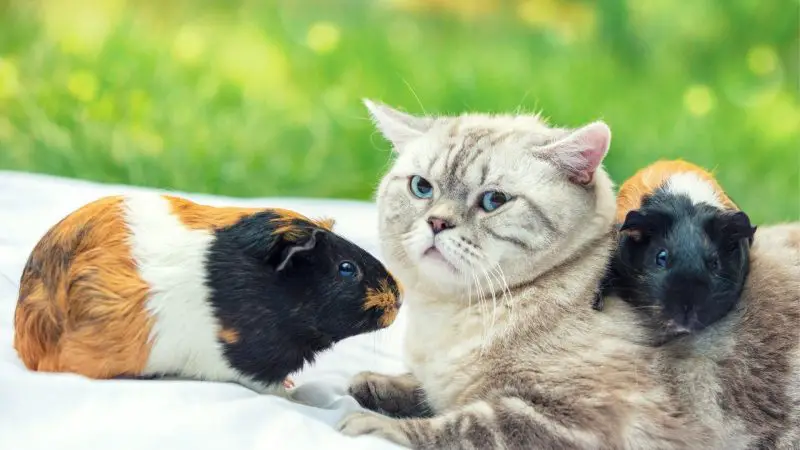
Whether things go smoothly comes down mostly to the cat, because the cat is the one with the power to do harm. There is a real difference between a high-energy, high-prey-drive cat and a laid-back one:
- Higher risk: young, energetic cats; keen hunters that bring home mice and birds; cats that fixate on movement, stalk the cage, or paw at it.
- Lower risk: older, calm, low-energy cats; cats raised around small pets; cats that glance at the cage and walk away.
Even a “lower risk” cat is never a no-risk cat. A relaxed cat can still react on instinct if a guinea pig suddenly bolts or squeals, so you judge each cat by what it actually does around the cage, and you never assume a quiet first week means the danger has passed.
The real risks of keeping cats and guinea pigs together
It helps to be clear-eyed about why caution matters. The danger is not only “the cat might eat the guinea pig.” There are three separate risks, and a guinea pig does not have to be eaten to be killed.
1. A single swipe can injure or kill
Guinea pigs are small and have no real defences. A cat’s claws and teeth can cause deep puncture wounds, broken bones, or fatal internal injuries in one swat. The cat does not have to be angry or hungry; a “play” swipe at a moving target is enough.
2. Fear alone can be fatal
This is the risk owners most often miss. As prey animals, guinea pigs are extremely sensitive to stress and they hide their fear well. The RSPCA notes that guinea pigs must be able to retreat to a safe place away from things that scare them. A cat that simply stares at or stalks the cage all day can frighten a guinea pig badly enough to stop it eating, and in a frail or weak-hearted pig, sustained terror can trigger fatal stress. Long-term fear also shows up as illness; chronic stress is linked to a range of guinea pig health problems.
3. A cat bite is a veterinary emergency
Around 70 to 90 percent of cats carry Pasteurella multocida bacteria in their mouths. In a small animal, even a tiny, almost invisible cat bite or scratch can seed a rapidly spreading infection that turns life-threatening within a day or two. Any cat bite or scratch on a guinea pig is an emergency. See an exotics-savvy vet the same day, even if your guinea pig seems fine and the wound looks minor, because antibiotics are far more effective started early.
Should you let your guinea pig and cat play together?
No. This is the single biggest change from old advice you will still find online. A predator and a prey animal should not be encouraged to “play,” and you should not aim for a shared playpen, shared toys, or cuddle-piles. What looks like gentle play from a cat can flip into a hunting response in an instant, and the guinea pig cannot tell the difference either way.
Cats are also very good at appearing calm. A cat may sit politely by the cage for weeks and then pounce the moment it gets a clear opportunity, so a peaceful start is never proof that play is safe. The realistic, healthy goal is mutual indifference under supervision: a cat that ignores the cage and a guinea pig that feels secure enough to behave normally.
How a guinea pig defends itself (it can’t)
A guinea pig’s first reaction to a threat is to freeze, hoping not to be noticed. If the danger continues, it tries to flee for cover. Fighting back is rare and weak; the most a cornered guinea pig can manage is a defensive nip, and guinea pig bites are no deterrent to a cat. In short, a guinea pig has no meaningful defence against a determined cat, which is exactly why the responsibility sits entirely with you.
How to introduce a guinea pig and a cat safely
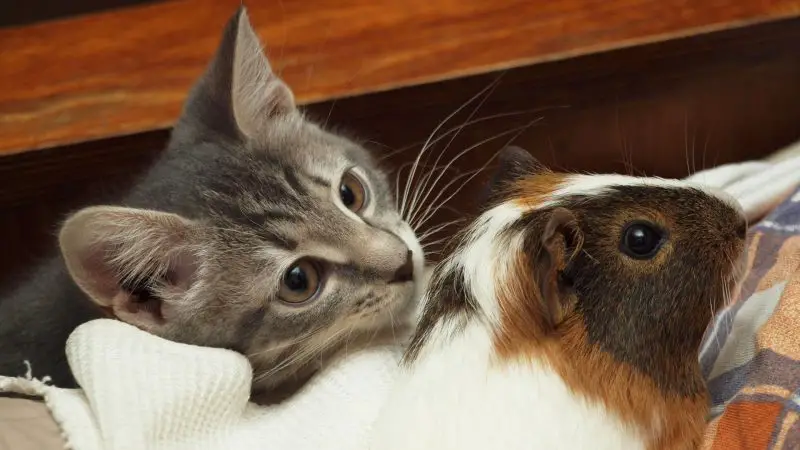
Introductions should be slow, calm and always with the guinea pig protected behind sturdy bars. The aim is for the cat to get bored of the guinea pig, not interested in it. Work through these steps and never rush to the next one:
- Let them share scent first. Before any face-to-face meeting, let each animal get used to the other’s smell from a distance. Scent is how both species read the world.
- Keep the guinea pig in a secure, lidded cage. Every early meeting happens with the guinea pig safely caged. The cat may approach and sniff; the guinea pig can retreat to a hideout if it wants to.
- Keep sessions short and controlled. Hold or gently restrain the cat, or have a second person do so, and keep first meetings to a few minutes. Several short, calm sessions beat one long tense one.
- Watch the body language and reward calm. A cat that looks relaxed and loses interest is doing well. A cat that crouches, stares, twitches its tail, or paws the cage is telling you to stop.
- Never force contact. If either animal is stressed, separate them and try again another day. Some cats and guinea pigs never progress beyond living in separate rooms, and that is a perfectly safe, successful outcome.
Note: older advice to “raise them together as babies” or to build a “shared play space” is not safe guidance. Early calm exposure may help a cat stay relaxed, but it never removes the predator instinct, and a guinea pig should always have its own predator-free space rather than a shared one.
How to keep your guinea pig safe with a cat in the house

Day-to-day safety comes down to good housing and firm routines. Follow these rules and the risk drops dramatically:
- Never leave them alone together. This is the rule that matters most. If you cannot watch them, the guinea pig is behind a secure cage in a separate space. No exceptions.
- Use a sturdy cage with a secure lid. The cage must be one a cat cannot open, climb into, or knock over. A solid lid stops a cat reaching in from above and stops it sleeping on top and stressing the pig. Get the housing right from the start with our guinea pig cage setup guide and our pick of the best guinea pig cages.
- Choose narrow bar spacing. Bars should be close enough that a cat cannot fit a paw through to swipe. Avoid open-topped enclosures and flimsy mesh in a cat household.
- Keep the cage in a cat-free room. The calmest setup is a room the cat simply cannot enter, so the guinea pig is never under a predator’s gaze. Our guide on where to put a guinea pig cage covers the best and worst spots.
- Give floor time only under supervision. When your guinea pig is out for exercise, the cat is shut out of the room or you are watching every second. Provide plenty of hideouts so the pig always has somewhere to dash to.
- Protect the guinea pig’s safe space. A frightened guinea pig that cannot escape can lose trust and become chronically stressed, so its area must always feel predator-free.
Signs it’s working — and signs to separate them
| Good signs (under supervision) | Warning signs (separate them now) |
|---|---|
| Cat ignores the cage or sits calmly nearby | Cat stalks, crouches, stares, or pounces at the cage |
| Relaxed cat body language, normal pupils, no fixation | Dilated pupils, twitching tail, flattened ears, tensed to spring |
| Guinea pig eats, popcorns, and explores normally | Cat paws at the cage or tries to reach through the bars |
| Both animals rest normally in the same room | Guinea pig freezes for long periods, stops eating, hides constantly, or loses weight |
If you see the warning signs, go back to keeping the animals in separate rooms. There is no prize for forcing a friendship, and a stressed guinea pig is an unhealthy one.
What about other pets?
The same prey-and-predator logic applies to dogs. If you also have a dog, read how dogs and guinea pigs get along before any introductions. The friendliest companions for a guinea pig are other guinea pigs; cats and dogs are housemates to be managed, not companions. If you are weighing up a same-cage roommate, see why guinea pigs and rabbits should not live together either.
Frequently asked questions
Can guinea pigs and cats live together?
Yes, many households keep both, but they can never be trusted alone together. A cat is a predator and a guinea pig is prey, so they share a home through careful separation and supervision, not by becoming playmates.
Will my cat eat or kill my guinea pig?
Some cats will, especially those with a strong hunting drive. Even a playful swipe can injure or kill a guinea pig, and a cat bite can cause a fatal infection. Never leave them together unsupervised.
Can a guinea pig die from stress caused by a cat?
Yes. Guinea pigs are prey animals and are very sensitive to stress. The constant presence or sight of a stalking cat can frighten a guinea pig badly enough to stop it eating or, in fragile pigs, trigger fatal stress.
Why is a cat bite or scratch a vet emergency for a guinea pig?
Cats carry Pasteurella bacteria in their mouths and on their claws. Even a small bite or scratch can cause a rapidly spreading infection that is often fatal in a small animal, so it needs urgent veterinary treatment.
How do I introduce a guinea pig to a cat safely?
Keep the guinea pig in a secure, lidded cage the cat cannot open or knock over. Let them get used to each other’s scent and presence through the bars first, keep all sessions short and supervised, and never force contact.
Can guinea pigs and cats ever be friends?
They can learn to tolerate and ignore each other, which is the realistic goal. A calm, low-energy cat may sit near the cage without reacting, but this is peaceful coexistence under supervision, not true friendship or play.
Related Guinea Pig Guides
- How to Take Care of a Guinea Pig: Beginner’s Guide
- Guinea Pig Cage Setup: The Complete Housing Guide
- Where to Put a Guinea Pig Cage: Best and Worst Spots
- What Are Guinea Pigs Afraid Of?
- Do Dogs and Guinea Pigs Get Along?
- Can Guinea Pigs and Rabbits Live Together?
- Guinea Pig Illnesses: The Full List
List of Sources
MSD Veterinary Manual — Pasteurellosis
University of Florida Small Animal Hospital — How to Care for Your Pet Guinea Pig